

Miracles happen again and again
Categorie: References

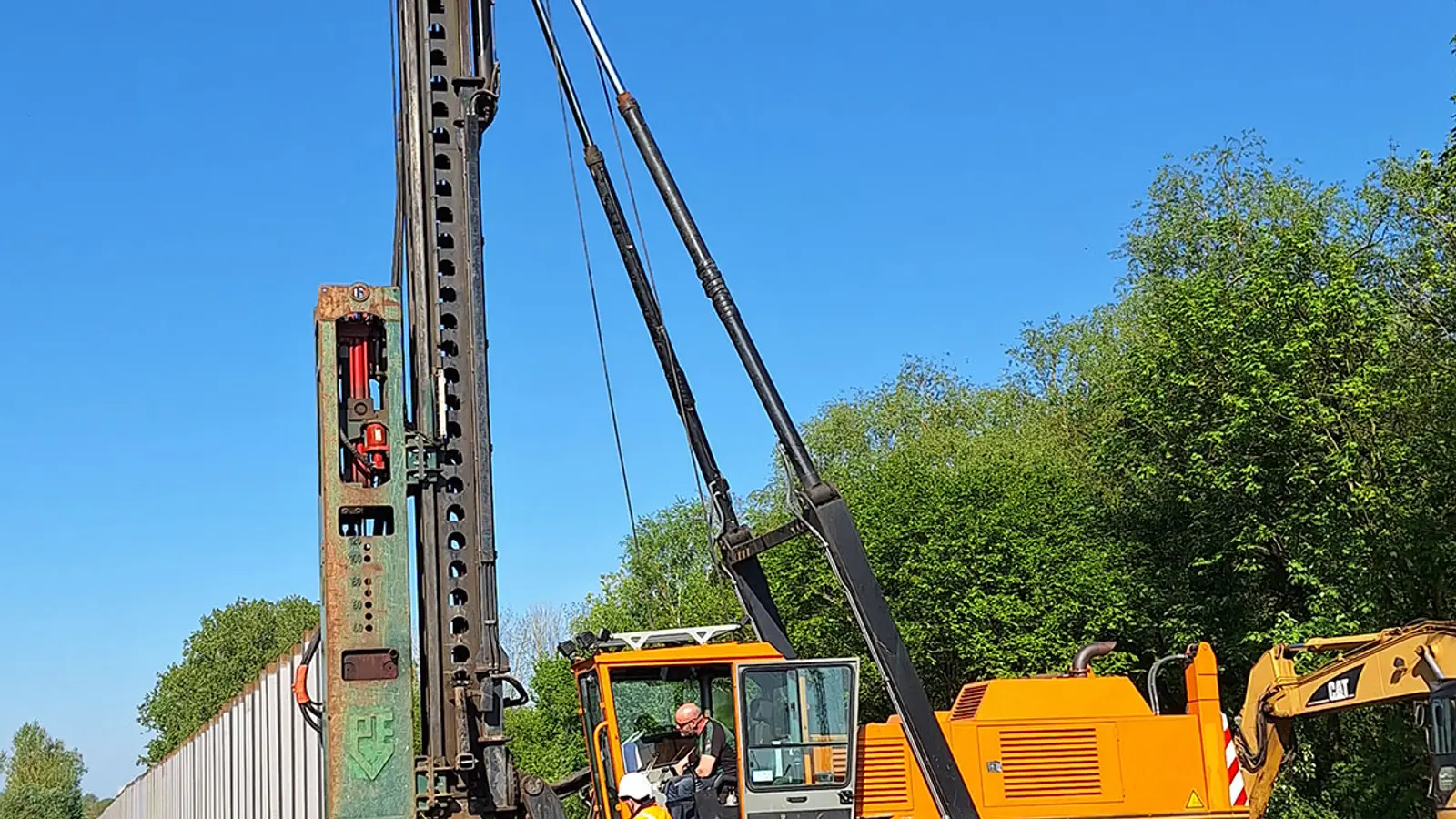
The Friesenbrücke bridge is a key structure on the 173 km long railway line, known as the Wunderline, between Groningen in the Netherlands and Bremen. In 2015, a cargo ship severely damaged the bridge. Since then, trains have not been able to pass and rail passengers have had to switch to a replacement bus service between Leer and Weener. Work on rebuilding the bridge has been underway since 2021. The Wunderline route is being modernized and expanded in two construction phases. The aim is to reduce travel times by increasing the maximum speed on the route and to create greater capacity by running more trains on the route. To implement the modernization measures, pre-coated sheet pile planks tkl 607 of steel grade S 355 GP and uncoated sheet pile planks tkl 607 of steel grade S 270 GP from terra infrastructure were used for the stabilization of the railway embankment on sections both west and east of the new bridge.
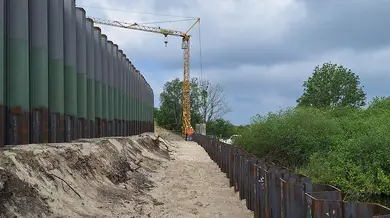
The modernization of the Wunderline is intended to improve the rail linkage between Groningen in the Netherlands and Bremen. This will enhance the important linkage between the two regions, which has not been continuously passable since the accident at the Friesenbrücke bridge. In addition to the construction and expansion of several engineering structures, the modernization also includes the track system. To this end, the first construction phase, which concerns the area between the Dutch limit and Ihrhove, has been divided into several construction lots, as Florian Henke, Wilhelm Becker GmbH & Co. KG, explains: "In addition to the lot for the construction of the Friesenbrücke bridge, there are also the two lots Wunderline East and Wunderline West, which concern the sections east and west of the Friesenbrücke bridge respectively. Our construction company is involved in both lots as a member of the DEPENBROCK Group. In the eastern section, for example, we are constructing the replacement for the Hilkenborger Straße railway underpass as a reinforced concrete trough structure with deep foundations and a steel superstructure, as well as a back-anchored steel sheet pile wall with a reinforced concrete head beam as a retaining wall over a length of around 160 meters. In the western section, we are also constructing a reinforced concrete head beam on another back-anchored steel sheet pile wall. Here, it has a length of around 310 meters."
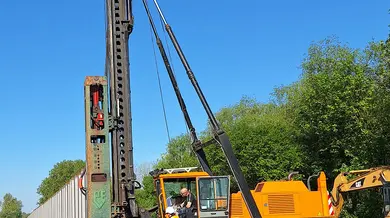
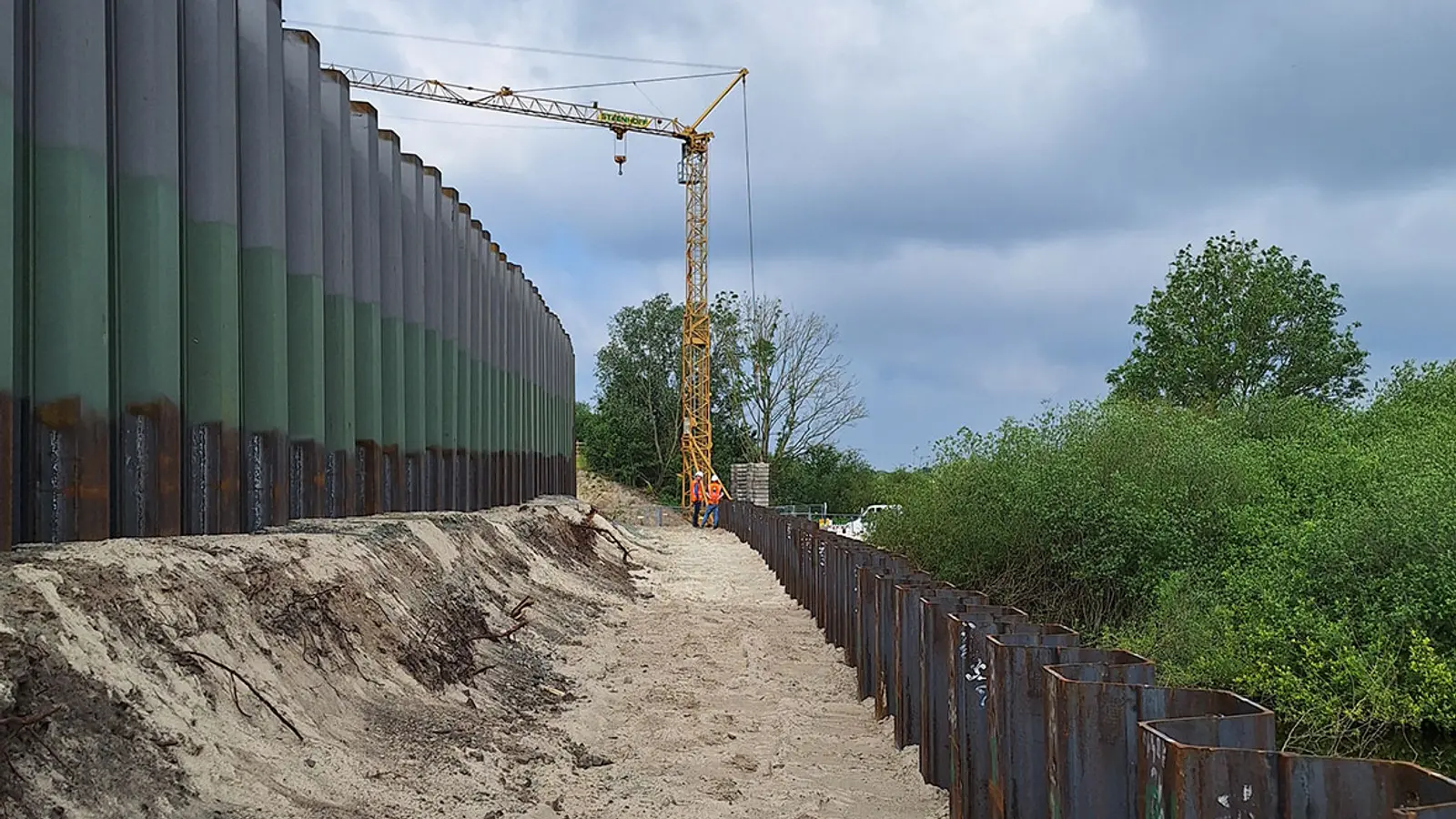
The two back-anchored Sheet piles are necessary because the future line speed is to be increased from 100 km/h to 120 km/h. This means that the existing embankment must be widened in some sections, but this is not possible everywhere due to local conditions. In these areas, the two back-anchored sheet piles serve as fuse protection. During the detailed planning, a special challenge arose for the eastern construction section, as terra field representative Tim Bartels explains: "The shorter sheet pile wall east of the Friesenbrücke bridge borders on a biotope worthy of protection. To enable construction work to be carried out in this area without negatively impacting the biotope, a second set of Sheet piles was driven parallel to the first, creating a temporary working level. Otherwise, it would not have been possible to back-anchor the actual Sheet piles, for example." The planks for this temporary wall are uncoated and will remain in the railway embankment after completion of the construction project and will simply be burned.
"We supply the U-planks as double sheet piles. Two individual planks are inserted into each other at the factory and the center lock is pressed together to provide shear resistance as standard. The structural analysis for this project specified seven pressing points per meter of sheet pile plank, which is more than twice as many as at average projects. With plank lengths between 9.50 meters and 12.70 meters, that added up to quite a lot,“ says Bartels. Here, Wilhelm Becker GmbH benefited from the expertise and clout of terra infrastructure. ”We see ourselves as a project and solution partner, which means that we provide our customers with the product or solution they need for their project," summarizes Bartels. One advantage that Henke came to appreciate in the project: “The temporary sheet pile wall was not included in the original plans. terra infrastructure provided support here and supplied both the structural analysis and the implementation planning from its in-house technical office.” In total, terra supplied around 1,400 tons of sheet pile planks tkl 607 in steel grades S 355 GP and S 270 GP for the project. The western sheet pile wall has a length of 310 meters. In the eastern construction section, both sheet pile walls have a length of around 160 meters.
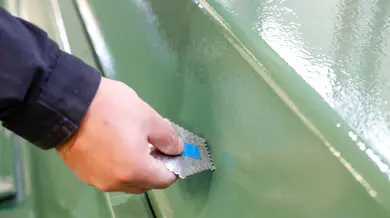
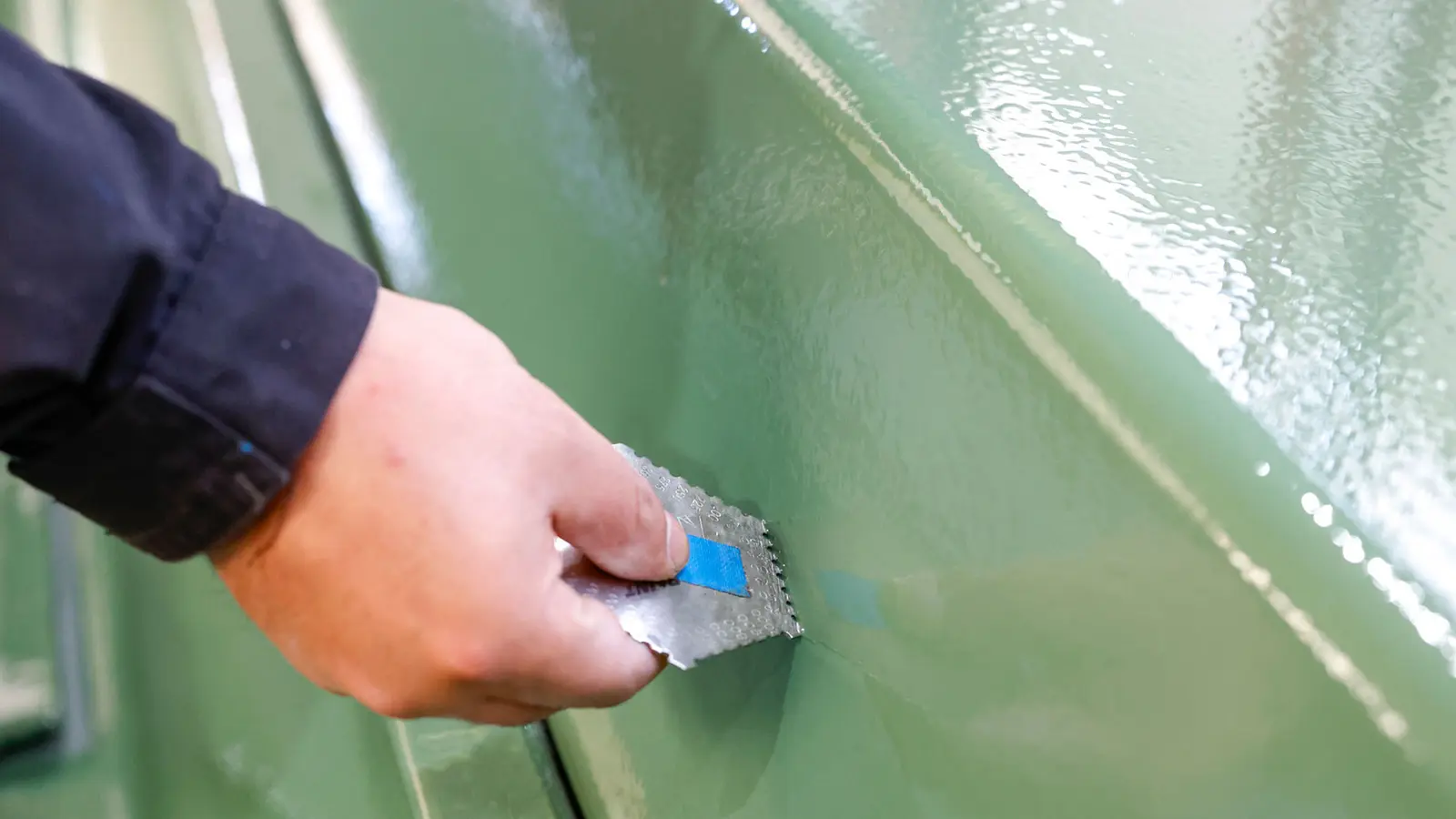
After the profiles were hot-rolled and manufactured into double sheet piles on a drawing line, they were first delivered to Dortmund in the Ruhr area for pre-coating. The coating serves as Corrosion protection and increases the service life of the sheet piles. “The decision to use factory pre-coating was mainly made for environmental reasons,” explains Henke. Coating the planks after installation on the site would have been very costly, and the sheet piles would have had to be completely enclosed in a tent for shot blasting. In addition, there would have been considerable disposal costs for the blasting material. If the factory-precoated double sheet piles are damaged during installation and/or transport, they can be repaired afterwards. “However, no protective measures such as enclosure are necessary for this,” says Henke.
In a first step, the double sheet piles were first blast-cleaned and dirt, grease, mill scale, and rust were removed. The Coating was applied in several coating thicknesses and steps in accordance with the client's specifications and comprised a zinc-containing primer (in grey colour), two intermediate coatings (green) and a further top coat (grey). This meant that the Coating color made it possible to see immediately which stage of the process the plank was currently undergoing. “We received precise information from terra infrastructure about the areas in which the individual planks were to be coated and the thickness of the Coating,” explains Frank Tapken, managing director of Dortmund-based Walter Hartmann Industrie-Großanstriche, maschinelle Sandstrahlentrostung GmbH & Co. KG. The areas where the anchor chairs for the back anchoring are welded to the Sheet piles were initially left out of the coating. The anchor chairs were delivered separately to Dortmund for pre-coating. Tapken: "The repair work on the pre-coating after completion of the back anchoring and the top coat of the Sheet piles and anchor chairs will then be executed on site by our employees. "
Work on the first construction phase is expected to be completed in the summer of 2025. The second construction phase involves the expansion of a two-track section between the German-Dutch border and Ihrhove, and between Stickhausen-Velde and Augustfehn. Once this has also been completed, the journey time between Bremen and Groningen will be less than two hours and 15 minutes, together with the first construction phase.